Services
Blog
Best Management Courses in Saudi Arabia 2026: 15 Courses to Build Leadership Skills
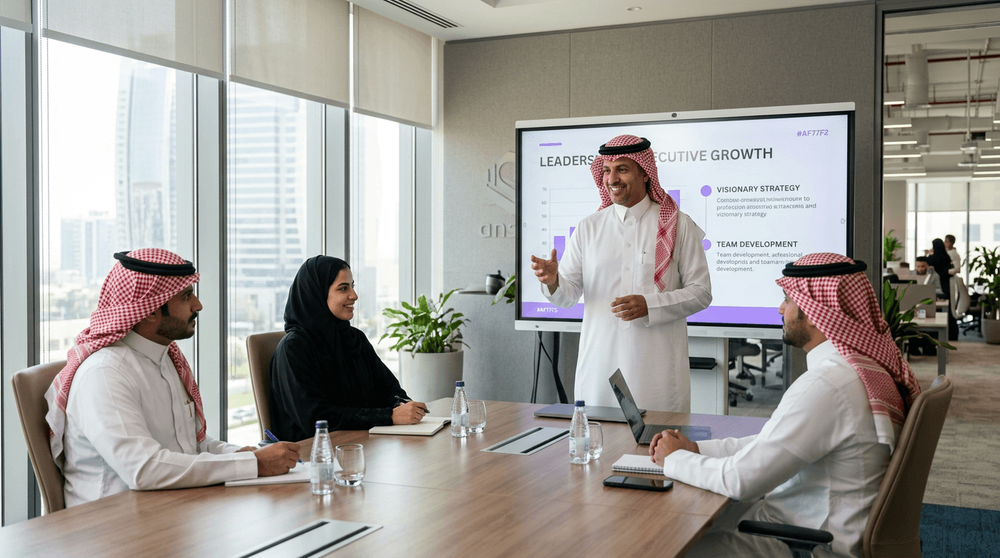
Management training is no longer just for brand-new managers. In Saudi Arabia’s fast-moving labor market, it has become a strategic necessity that reaches from frontline supervisors to executive leaders. Why? Because organizations that do not invest in developing their leaders often end up with a strange equation: technically strong employees who still struggle to lead teams, manage change, and make decisions under pressure.
Time to Read
7 Min
Published on
And the numbers are hard to ignore. In 2025, 77% of organizations worldwide admitted they have a leadership skills gap that holds back performance. At the same time, leadership development programs deliver an average 29% return on investment. In Saudi Arabia, the pressure is even more urgent. Vision 2030 has created unprecedented demand for qualified Saudi leaders across tourism, energy, entertainment, technology, and financial services — sectors that historically relied heavily on expatriate leadership.
The Saudi leadership and executive training market has reached $2.3 billion, while participation by Saudis in international executive programs is rising faster than ever. London Business School alone recorded 250% growth in Saudi registrations over four years, with 350% growth in Saudi women’s participation during the same period.
This guide brings you a numbered list of 15 accredited management courses for different levels and sectors — with duration, cost, and suitability details — to help decision-makers build a real, structured management development plan.
If you want a broader look at accredited training across all specialties, see: Accredited Training Courses in Saudi Arabia 2026: The Complete Guide to the Best Courses with Recognized Certificates.
Why Management Training Is a Priority, Not a Luxury in 2026
Before we jump into the list, it helps to understand the environment these courses are designed for. Once you see the bigger picture, training stops looking like an optional expense and starts looking like a business shield
Saudi organizations are not only hiring managers. They are building future leaders in a market that is changing quickly, competing globally, and demanding more human-centered leadership.
1) Nationalization pressure is not only about jobs — it is about leadership roles
Saudi initiatives such as Nitaqat classify organizations based on Saudization levels. But the deeper challenge is not just filling operational positions with Saudi talent. It is localizing leadership roles too.
If an organization places Saudi employees in supervisory or administrative titles without giving them real leadership skills, it creates hidden fragility. You get job titles. But not institutional strength.
2) 675 multinational companies are reshaping the Saudi workplace
The Regional Headquarters (RHQ) program brought companies like Amazon, Microsoft, General Electric, PepsiCo, and Siemens into Riyadh. That creates a workplace shaped by global leadership standards.
In this environment, a Saudi manager who lacks professional communication skills, team management capabilities, and strategic decision-making may find it difficult to compete for leadership roles. The bar is higher now. And that is not bad news — it is a call to grow.
3) A young workforce needs a new style of leadership
Around 60% of Saudi Arabia’s population is under 30. Leading this generation requires a different playbook than the one used with older workforces. It calls for emotional intelligence, transparent communication, measurable performance management, and motivation built on purpose, not just orders.
Global studies show that employee trust in managers fell from 46% to 29% between 2022 and 2024. That decline hits retention, morale, and team productivity. So yes, leadership training matters. A lot.
The 15 Management Courses in Saudi Arabia, Ranked by Level
To make this easy to scan, the list is grouped by skill level. That way, you can choose the right course for a new supervisor, a middle manager, or a senior executive.
Beginner Level: For Supervisors and New Managers
These courses are the foundation. Think of them as the bricks before the building. Without them, everything else gets shaky.
1. Management Essentials
Level: Beginner | Duration: 3–5 days | Approximate cost: SAR 3,000–6,000 | Accreditation: TVTC-accredited centers or CPD | Targeted support: Partial
This is the natural starting point for anyone moving from employee to supervisor or manager. It covers the basics: the difference between leadership and management, situational leadership styles, task allocation, prioritization, and how to build trust with the team.
In the Saudi market, this course matters a lot because 60% of first-time managers globally received no training when they stepped into management roles in 2025. The local figure is likely just as serious, if not more so.
If you are newly promoted, this is the course that helps you avoid learning everything by trial and error on your team’s time.
2. Effective Administrative Communication Skills
Level: Beginner | Duration: 3 days | Approximate cost: SAR 2,500–5,000 | Accreditation: CPD / accredited local centers | Targeted support: Available
Communication is the most mentioned skill in management job descriptions — and one of the most missing in real life. Funny, isn’t it?
This course covers upward and downward communication, running effective meetings, giving constructive feedback, and communicating in multicultural environments. That last part is especially important in Saudi Arabia’s growing multinational workplace.
Good communication is not about sounding fancy. It is about making sure people actually understand you.
3. Time Management and Managerial Productivity
Level: Beginner | Duration: 2–3 days | Approximate cost: SAR 2,000–4,500 | Accreditation: CPD / locally accredited | Targeted support: Partial
If a manager works 12 hours a day but achieves less than a colleague who works 8 hours, the issue is not effort. It is priorities.
This course teaches the Eisenhower Matrix, weekly planning methods, meeting control, and effective delegation. In Saudi workplaces where project execution is accelerating, productivity is no longer a “nice to have.” It is measurable value.
4. Performance Management and Team Development
Level: Beginner to Intermediate | Duration: 3–5 days | Approximate cost: SAR 3,500–7,000 | Accreditation: CPD / internationally accredited | Targeted support: Available
This course is at the heart of what managers actually do. It includes SMART goal setting, performance reviews, individual development plans, and managing low performance.
Gallup studies show that 70% of employee engagement variance is directly linked to the immediate manager, not company policy. That means your manager is not just “part of the system” — they are often the system.
If your organization wants to retain talent, this is one of the smartest courses to start with.
Intermediate Level: For Managers and Middle Leaders
This is where the jump happens. From handling tasks to handling complexity. From “doing the work” to “directing the work.”
5. Strategic Thinking and Decision-Making
Level: Intermediate | Duration: 4–5 days | Approximate cost: SAR 5,000–10,000 | Accreditation: Internationally accredited / CPD | Targeted support: Available
The move from operational thinking to strategic thinking is one of the hardest transitions in any career.
This course covers external environment analysis using PESTLE and SWOT, linking daily decisions to strategic goals, decision-making frameworks under uncertainty, and scenario thinking.
In Saudi Arabia’s fast-changing sectors — especially entertainment, tourism, and technology — a leader who can read the business environment is worth their weight in gold.
6. Organizational Change Management
Level: Intermediate | Duration: 4–5 days | Approximate cost: SAR 6,000–12,000 | Accreditation: Prosci / APMG / CPD | Targeted support: Available
Change management is the skill that makes or breaks digital transformation, restructuring, and Vision 2030 initiatives.
This course covers Kotter’s 8-step model, resistance management, internal coalition building, and communication of change across different organizational levels.
Companies that carry out strategic transformation without leaders trained in change management face serious risk. McKinsey data shows transformation failure rates can reach 70%.
That is a huge number. And a very expensive one.
7. Emotional Intelligence in Leadership
Level: Intermediate | Duration: 3–4 days | Approximate cost: SAR 4,500–9,000 | Accreditation: CPD / TalentSmart / internationally accredited | Targeted support: Partial
Emotional intelligence is no longer a soft skill. It is a leadership requirement.
TalentSmart reports that 90% of top performers in the workplace have high emotional intelligence. In Saudi Arabia, where managers often lead mixed-age and multicultural teams, self-awareness and empathy are not extra decorations. They are core tools.
This course covers self-awareness, emotional regulation, empathy, and social skills as one connected leadership system.
8. Project Management Professional (PMP) Preparation
Level: Intermediate to Advanced | Duration: 5–8 days | Training hours: 35 required hours | Approximate cost: SAR 4,000–8,000 for the course + SAR 1,500–2,000 exam fee for PMI members | Accreditation: PMI Authorized Training Provider | Targeted support: Available
PMP is not just another management course. It is one of the most in-demand certifications in the Saudi market, with more than 41,000 holders.
It covers PMBOK 8, Agile and hybrid methods, scope, time, cost, risk management, and stakeholder leadership. PMP holders often see salary increases of 20% to 30%.
If you want professional recognition and practical management growth in one move, PMP is a strong candidate.
For a broader comparison of PMP providers and management training options in Saudi Arabia, see: Best Training Companies in Saudi Arabia 2026: A Complete Guide to Prices, Specialties, and Accreditations.
9. Leadership in Diversity and Inclusion
Level: Intermediate | Duration: 3 days | Approximate cost: SAR 4,000–8,000 | Accreditation: CPD / internationally accredited | Targeted support: Partial
In most private-sector Saudi organizations, teams are culturally diverse. So leading diversity is not a side skill. It is a business skill.
This course helps leaders build an inclusive culture that improves performance, reduces conflict, and raises retention. McKinsey data shows that organizations with stronger leadership diversity generate 25% better financial returns than peers in the same sector.
That is not just good ethics. That is smart business.
10. Priority Management and Internal Negotiation
Level: Intermediate | Duration: 3–4 days | Approximate cost: SAR 4,000–8,000 | Accreditation: CPD / locally accredited | Targeted support: Available
Middle management lives under double pressure: top-down demands from executives and bottom-up needs from teams.
This course gives managers the tools to negotiate internally, manage expectations across levels, and set priorities under limited resources. It is one of those everyday survival skills that training catalogs often overlook — even though managers use it constantly.
Advanced Level: For Executive and Senior Leadership
Now we move into the big leagues. This is where managers stop thinking only about departments and start thinking about direction, growth, and legacy.
11. Strategic Leadership and Business Development
Level: Advanced | Duration: 5 days | Approximate cost: SAR 10,000–20,000 | Accreditation: Internationally accredited / global business school partnerships | Targeted support: Partial
This course is for executives moving from managing functions to leading direction.
It covers corporate vision building, identifying opportunities in emerging markets, managing board relationships, and connecting human capital strategy to business strategy.
In Saudi Arabia’s Vision 2030 environment, this is not optional for executive leaders. It is foundational.
12. Corporate Coaching & Mentoring
Level: Advanced | Duration: 4–6 days | Approximate cost: SAR 8,000–16,000 | Accreditation: ICF / ILM / CPD | Targeted support: Available
Corporate coaching has moved from being an external service to an internal leadership capability.
A leader who can use the GROW model in development conversations and mentor emerging talent builds a culture of continuous learning. That means less dependence on outside coaches and deeper internal growth.
In simple terms: you grow leaders instead of just managing workers.
13. Digital Transformation Leadership for Non-Technical Leaders
Level: Advanced | Duration: 3–5 days | Approximate cost: SAR 8,000–18,000 | Accreditation: Internationally accredited / CPD | Targeted support: Available
Senior leaders without technical backgrounds now face a double challenge: making strategic decisions in complex tech projects without being engineers themselves.
This course gives them enough understanding to make informed decisions. It covers AI basics, data foundations, digital project management, working with tech teams, and reading digital KPIs.
Saudi Arabia’s digital economy is being pushed toward SAR 495 billion by the Ministry of Communications and Information Technology. Leaders who do not understand this environment are falling behind.
14. Mini MBA for Executive Preparation
Level: Advanced | Duration: 8–12 weeks | Format: Part-time or intensive | Approximate cost: SAR 15,000–35,000 | Accreditation: International or locally accredited business schools | Targeted support: Partial
This is the smart alternative for leaders who do not want or cannot commit to a full MBA.
A Mini MBA gives the core business frameworks in a focused format: finance for non-financial managers, strategic marketing, supply chains, and corporate leadership.
In Saudi Arabia, this program is becoming increasingly popular with companies that want to prepare future leaders without pulling them out of work for two full years.
15. Executive Leadership Programs from Global Institutions (LBS / INSEAD / IMD)
Level: Advanced to Senior Executive | Duration: 1–4 weeks | Approximate cost: SAR 50,000–150,000 | Accreditation: Top-ranked international business schools such as LBS, INSEAD, IMD, or Harvard Executive | Targeted support: Limited
This is the highest investment on the list — and potentially the highest return in leadership positioning.
London Business School opened its Riyadh office in 2025 and aims to train 10,000 Saudi managers by 2030. IE Business School is also preparing to launch a campus in Riyadh.
These programs are especially attractive for senior leaders in major Saudi companies and government entities. The value is not only in the content. It is also in the global network you build with peers from different industries and regions.
That network can be a career accelerator in itself.
Quick Comparison Table of the 15 Courses
Here is a simple snapshot to help you compare quickly:
| # | Course | Level | Duration | Cost (SAR) | Ta'aleem / Hadaf Support |
|---|---|---|---|---|---|
| 1 | Management Essentials | Beginner | 3–5 days | 3,000–6,000 | Partial |
| 2 | Effective Administrative Communication | Beginner | 3 days | 2,500–5,000 | Yes |
| 3 | Time Management and Productivity | Beginner | 2–3 days | 2,000–4,500 | Partial |
| 4 | Performance Management and Team Development | Beginner–Intermediate | 3–5 days | 3,500–7,000 | Yes |
| 5 | Strategic Thinking and Decision-Making | Intermediate | 4–5 days | 5,000–10,000 | Yes |
| 6 | Organizational Change Management | Intermediate | 4–5 days | 6,000–12,000 | Yes |
| 7 | Emotional Intelligence in Leadership | Intermediate | 3–4 days | 4,500–9,000 | Partial |
| 8 | PMP Preparation | Intermediate–Advanced | 5–8 days | 4,000–8,000 | Yes |
| 9 | Diversity and Inclusion Leadership | Intermediate | 3 days | 4,000–8,000 | Partial |
| 10 | Priority Management and Internal Negotiation | Intermediate | 3–4 days | 4,000–8,000 | Yes |
| 11 | Strategic Leadership and Business Development | Advanced | 5 days | 10,000–20,000 | Partial |
| 12 | Corporate Coaching & Mentoring | Advanced | 4–6 days | 8,000–16,000 | Yes |
| 13 | Digital Transformation Leadership | Advanced | 3–5 days | 8,000–18,000 | Yes |
| 14 | Mini MBA | Advanced | 8–12 weeks | 15,000–35,000 | Partial |
| 15 | Executive Leadership (LBS/INSEAD/IMD) | Senior Executive | 1–4 weeks | 50,000–150,000 | Limited |
How to Build an Institutional Training Plan, Not Just a Course List
This is where many organizations go wrong. They treat training like a supermarket: one course here, another there, and hope that leadership magically appears at the checkout counter.
It does not work that way.
A real training plan starts with one simple question:
What leadership competencies will your organization need over the next 3 years to reach its strategic goals?
From that question, three paths usually emerge.
Path 1: Develop the frontline supervisory layer
This starts with courses 1–4. The goal is simple: give those managing daily work the tools to lead properly.
Path 2: Prepare middle management
This uses courses 5–10. The aim is to build leaders who can connect strategy with execution — and that is often the hardest jump in the chain.
Path 3: Build the executive succession pipeline
This uses courses 11–15. The goal is to prepare the next generation of senior leaders with both global awareness and local strategic depth.
Organizations that invest in leadership achieve better business results by 25%, according to the DDI Global Leadership Forecast 2024. But there is a condition: training must be structured and tied to measurable KPIs — not random courses that nobody remembers afterward.
Coursinity and Management Training: A Partner, Not Just a Provider
Real management training does not begin with a course catalog. It begins with a careful look at the organization: its needs, culture, challenges, and goals.
Coursinity designs management training as a tailored system. It identifies leadership gaps through objective analysis, builds programs around the organization’s sector and leadership levels, and measures impact using real performance indicators — not just a smile sheet at the end of the course.
If you want to create a meaningful leadership pipeline, the smart move is not to buy a course. It is to build a learning journey.
Register for the next management course with Coursinity. Or contact the training solutions team to analyze your organization’s needs and design a management development path that creates measurable impact
Frequently Asked Questions About Management Courses in Saudi Arabia
What is the difference between management courses and leadership courses?
Management courses focus on tools and frameworks for managing work: time, performance, projects, and resources. Leadership courses focus more on human influence: motivation, trust-building, crisis leadership, and decision-making.
In practice, a strong manager needs both. That is why many modern programs blend the two.
Are management courses supported by Hadaf?
Many of them are, but not all. Programs accredited by bodies such as CPD, ILM, ICF, and some courses listed in Hadaf’s approved catalog may qualify.
Always check the latest Hadaf list or ask the training provider directly before enrolling.
Which management course is best for a new manager?
A manager who has just moved from an operational role into a management role will benefit most from:
- Management Essentials
- Performance Management and Team Development
These two build the core skills needed to start with confidence instead of guesswork.
Which management courses are most in demand in Saudi Arabia?
According to 2026 market trends, the most requested are:
- PMP for project management
- Change management
- Strategic thinking
- Emotional intelligence
These are especially important in organizations experiencing rapid growth, digital transformation, or large-scale national projects.
Can these courses be delivered for groups inside a company?
Yes. Most providers offer in-house versions of these programs. That means the content is customized for one organization, based on its real challenges and work environment.
This model usually works better than sending employees to a generic public course because the learning connects directly to the organization’s reality.
Latest words
If you are leading people in Saudi Arabia today, your job is not just to supervise tasks. It is to shape confidence, direction, and resilience. That takes skill. And skill can be built.
The good news? You do not need to do everything at once. Start with the level that matches your current role. Build step by step. One course can sharpen your tools. A well-designed learning path can change your whole leadership style.
Think of management development like tuning an orchestra. Every section matters. If one instrument is off, the whole sound suffers. But when the team is trained, aligned, and led well, the result is powerful and hard to ignore
So here is your small challenge: Which of these 15 courses would make the biggest difference in your team right now?
Share this post
Latest Posts

Blog
Employee training programs in Saudi Arabia compared by price, results, and ROI. Discover the best option for your organization today.
6 Min Read

Article
Saudi Arabia’s private sector in 2026 is moving fast, but not gently. It is being pulled in two directions at once: compliance pressure on one side, and massive Vision 2030 growth on the other. If you run a private company in the Kingdom, training is no longer a nice extra. It is the engine under the hood
7 Min Read
Article
When you’re browsing a training catalog, most courses look like they belong to the same family: expert trainer, polished slides, neat agenda, certificate at the end. But the real difference often shows up later when your employee tries to use that certificate in a tender, a professional license renewal, or a government support program… and suddenly, the paper in hand is not enough. So, which one should you choose: accredited courses or non-accredited courses?
7 Min Read