Services
Blog
Corporate Training & Vision 2030: Empowering Saudi Talent
Book a demo and experience how a branded Coursinity Academy can elevate your training.

Time to Read
9 Min
Published on
Saudi Arabia’s Vision 2030 marks a turning point in the Kingdom’s journey, transforming the economy, revitalizing society, and preparing its institutions for a dynamic future. Central to this transformation is the empowerment of human capital. It is not enough to invest in infrastructure or technology; sustainable progress depends on developing people with the right skills, mindset, and leadership capacity.
This is where corporate training becomes indispensable. Far from being a peripheral function, it is now a strategic enabler of Vision 2030, fueling national development by equipping individuals and institutions to meet the demands of an evolving world.
Unlocking Vision 2030 Through Human Capital Development
Vision 2030 identifies a capable, ambitious workforce as a cornerstone of national success. But achieving that vision requires more than policy declarations; it demands strategic workforce development that aligns with sectoral priorities, economic diversification, and digital transformation.
Corporate training bridges the gap between potential and performance. Whether through public sector upskilling initiatives or advanced leadership development programs, professional training is the mechanism by which Saudi Arabia turns its ambitious goals into measurable outcomes.
Benefits of Upskilling the Public Sector Workforce
The public sector is undergoing unprecedented modernization. From digitizing services and improving citizen experiences to managing data-driven decisions, government entities must adapt swiftly. Strategic training ensures public employees don't just react to change but actively lead and shape it.
Training initiatives focused on change management, digital literacy, innovation, policy development, and advanced data skills align workforce performance closely with institutional objectives. The adoption of advanced learning management systems (LMS) further amplifies this transformation, offering scalable, personalized, and measurable learning pathways. The following are the tangible benefits of upskilling the public sector workforce:
Institutional Strength and Resilience
Robust training programs equip public sector employees with the agility and adaptability needed to navigate complex, rapidly evolving environments. Teams become proactive problem solvers, capable of swiftly implementing digital solutions, handling crises effectively, and achieving the strategic outcomes of Vision 2030.
Leadership at Every Level
Effective training fosters leadership competencies across all organizational levels, nurturing accountability, strategic foresight, digital proficiency, and a culture of innovation. By empowering individuals at every tier, organizations unlock internal transformation and accelerated achievement of Vision 2030 goals.
Enhanced Employee Engagement and Talent Retention
Investing in employee development demonstrates genuine commitment, signaling that the organization values its workforce and their career growth. This investment boosts morale, deepens loyalty, and strengthens Saudization efforts, ultimately creating an attractive, competitive workplace. Research indicates that organizations prioritizing employee development experience significantly higher retention rates and overall employee satisfaction.
Policy Alignment and Compliance Readiness
As regulations rapidly evolve in alignment with Vision 2030, tailored training ensures organizations maintain compliance, uphold ethical standards, and follow unified strategic directives. Employees become better prepared to adapt swiftly to regulatory changes, reducing organizational risk and enhancing overall efficiency.
By embedding upskilling deeply into public-sector practices, Saudi Arabia not only meets immediate modernization challenges but also lays a strong foundation for sustained growth, innovation, and national excellence.
The Power of Customized Corporate Learning
No two organizations and no two industries share the same training needs. Off-the-shelf content often misses the mark. That’s why leading organizations in Saudi Arabia are turning to bespoke corporate training solutions tailored to their sector, strategy, and people.
In sectors like healthcare, finance, oil & gas, education, and logistics, success depends on highly contextual learning. Programs that consider language, culture, workflow, and future sector trends are significantly more impactful in driving performance.
This is not just best practice, it’s a strategic necessity.
From Optional to Essential: A New Training Mandate
In today’s environment, corporate learning is a requirement, not a luxury. Organizations that embed training into their strategic planning will emerge more agile, more competitive, and more aligned with the Kingdom’s transformation agenda.
Investing in people isn’t merely a sound business decision; it’s a responsibility toward national progress.
Challenges in Workforce Development for Vision 2030
Despite strong momentum behind Vision 2030, several underlying challenges can limit the impact of workforce development efforts. Understanding and addressing these barriers is critical for any organization aiming to deliver effective, high-impact training.
Addressing the Skills Gap in Saudi Arabia
Saudi Arabia is undergoing rapid economic diversification, which has revealed significant skills shortages, especially in digital finance, advanced data analysis, green energy, and leadership for innovation. Universities and vocational institutions are expanding their offerings, but the pace of upskilling often lags behind sector demands. This gap can hinder both private enterprises and public agencies in executing Vision 2030 initiatives.
Overcoming Barriers to Public Sector Upskilling
Public sector transformation often requires more than just technical training. Cultural resistance can arise when new methods challenge hierarchical norms. Regional disparities in digital access and infrastructure can limit consistent training delivery. Additionally, demonstrating return-on-investment (ROI) poses a challenge when tracking tools and analytics frameworks are underdeveloped. These barriers must be thoughtfully addressed in training design and organizational planning.
Strategies for Effective Corporate Training Programs
To ensure training delivers real value, organizations should consider the following strategic approaches:
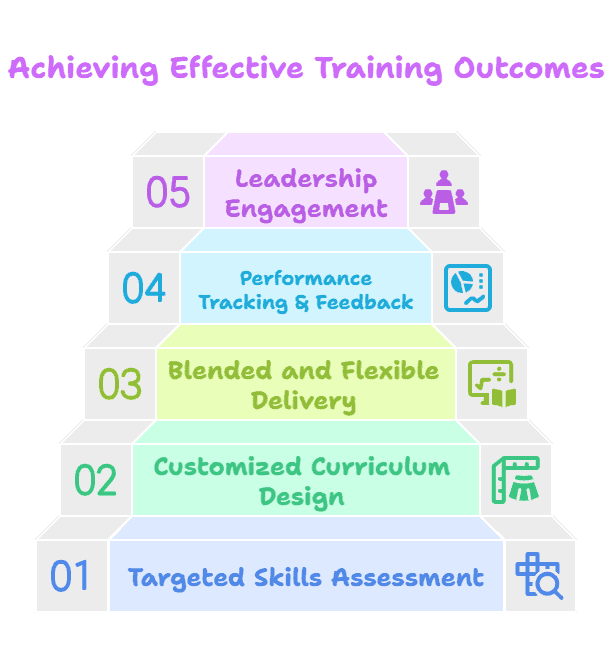
Targeted Skills Assessment
Begin by mapping existing capabilities against Vision 2030’s priority areas such as digital maturity, sustainability, and localization. This reveals precise training needs tied to current and future roles.
Customized Curriculum Design
Align learning content to real-world scenarios and sector-specific challenges. This may include workshops on emerging technologies, localization strategies, regulatory compliance, and customer-centric service in local contexts.
Blended and Flexible Delivery
Use a mix of learning formats, such as microlearning, e-learning modules, onsite workshops, and peer coaching. Blended models improve engagement and ensure knowledge is absorbed and applied on the job.
Performance Tracking & Feedback
Implement dashboards to measure training outcomes—such as performance improvements, localization rates, digital adoption, and innovation indicators. This provides objective evidence of impact and informs continuous improvement.
Leadership Engagement
Secure visible involvement from senior and middle managers. When leaders model new behaviors and reinforce learning, it helps build a supportive culture and positions training as part of the organization’s mission rather than an optional activity.
COURSINITY: YOUR PARTNER IN VISION-ALIGNED WORKFORCE TRANSFORMATION
At Coursinity, we believe in empowering progress. Our corporate training solutions are more than instructional; they’re transformational. We work closely with Saudi institutions to design learning journeys that reflect the priorities of Vision 2030 while addressing the day-to-day realities of their teams.
From digital fluency to leadership cultivation, we deliver culturally relevant, data-driven, and fully localized training programs that produce real outcomes. With Coursinity, you don’t just prepare for the future, but you shape it.
Let us be your partner in building the workforce that drives Saudi Arabia’s transformation forward.
Frequently Asked Questions
1. How does corporate training support Vision 2030?
It equips individuals and organizations with critical skills that align with national development, policy transformation, and sector innovation.
2. Why should organizations prioritize customized training?
Because sector-specific challenges and cultural contexts require targeted, relevant, and practical learning solutions to drive real change.
3. What types of training are most relevant for the public sector?
Change management, leadership development, digital services, compliance, and performance management are key for government bodies.
4. What are the benefits of upskilling the public sector workforce in Saudi Arabia?
Upskilling enhances institutional agility, strengthens leadership pipelines, boosts employee engagement, and ensures alignment with regulatory and national development goals, ultimately driving better service delivery and transformation outcomes.
5. What makes Coursinity a strategic training partner?
Coursinity combines local insight with instructional design expertise to deliver programs that are culturally attuned, results-driven, and aligned with Vision 2030 imperatives.
Key Points (TL;DR)
- Corporate training is a strategic pillar of Vision 2030, not a support function.
- Government transformation and economic diversification depend on skilled, agile talent.
- Customized learning—tailored by sector and culture—produces lasting organizational impact.
- Training enhances leadership, performance, compliance, and national alignment.
- Coursinity offers Saudi organizations localized, measurable, and future-ready training programs.
Share this post
Latest Posts

Blog
Employee training programs in Saudi Arabia compared by price, results, and ROI. Discover the best option for your organization today.
6 Min Read

Article
Saudi Arabia’s private sector in 2026 is moving fast, but not gently. It is being pulled in two directions at once: compliance pressure on one side, and massive Vision 2030 growth on the other. If you run a private company in the Kingdom, training is no longer a nice extra. It is the engine under the hood
7 Min Read

Article
When you’re browsing a training catalog, most courses look like they belong to the same family: expert trainer, polished slides, neat agenda, certificate at the end. But the real difference often shows up later when your employee tries to use that certificate in a tender, a professional license renewal, or a government support program… and suddenly, the paper in hand is not enough. So, which one should you choose: accredited courses or non-accredited courses?
7 Min Read