Services
Blog
Upskilling the Public Sector: Challenges and Opportunities in Saudi Arabia
Explore the key challenges and strategic opportunities in upskilling Saudi Arabia's public sector workforce under Vision 2030. Learn actionable insights and solutions.

Time to Read
7 Min
Published on
As Saudi Arabia moves forward with its Vision 2030 goals, one thing is increasingly evident: the transformation of the public sector relies heavily on the skills, agility, and readiness of its workforce. Ministries, municipalities, and government agencies across the Kingdom are advancing rapidly, but with these bold ambitions come significant challenges, along with promising opportunities. From rising citizen expectations to evolving labor laws and expanding digital government services, public sector upskilling must be approached with both strategic intent and cultural insight.
This article takes a close look at the key challenges facing government leaders today and explores practical, forward-looking opportunities to build a capable, future-ready workforce, showing how these obstacles can be transformed into stepping stones for long-term success. Keep reading.
Challenges in Upskilling the Public Sector Workforce
Upskilling the public sector is not simply a matter of providing more training, it’s about reshaping how government institutions learn, adapt, and perform in a rapidly changing environment. While the ambition is clear, the path is filled with practical hurdles that must be addressed head-on for training initiatives to truly support national transformation. Here’s a closer look at the key barriers standing in the way.
Digital Infrastructure and Accessibility
While government offices in major cities often have strong digital infrastructure, remote or regional branches may not. Weak internet connectivity, lack of modern devices, or outdated systems can limit access to online training. For e-learning or AI-based platforms to succeed, equal digital access is essential across the public sector.
Cultural Resistance and Organizational Hierarchy
One of the most persistent challenges is cultural resistance. Many public institutions still operate within rigid hierarchies, making it difficult to introduce new learning models or performance-based evaluations. Shifting from seniority-based systems to agile, skills-focused structures requires not just training but a cultural transformation.
Budget Constraints and Measurable ROI
Ministries are being held accountable for how they spend on learning and development. Budget approvals increasingly depend on proof of return on investment. Leaders need to demonstrate how training has improved employee performance, service delivery, or citizen satisfaction, but many struggle to connect the dots without proper tools or frameworks.
Skill Gaps and Generic Content
Each government department has unique challenges. A one-size-fits-all training model rarely delivers real results. Employees often disengage when content feels irrelevant or too theoretical. Upskilling must be role-specific, localized, and practical to be effective.
Lack of Long-Term Measurement
Short-term metrics like course completion rates are easy to track, but public sector training must deliver long-term results. Institutions need systems to evaluate whether training actually improves decision-making, policy outcomes, or frontline service performance over time.
Turning Challenges into Opportunities
While the hurdles to public sector upskilling are real, they are not insurmountable. In fact, many ministries and agencies in Saudi Arabia are already proving that innovation, leadership, and the right tools can turn these barriers into strategic advantages. From AI-driven platforms to flexible learning models and stronger public-private partnerships, there are powerful solutions available for those ready to act. Here’s how forward-thinking institutions are leading the way.
AI-Powered Personalized Learning
Saudi Arabia’s National Skills Platform is a leading example of how AI can personalize learning for thousands of government employees. By analyzing individual roles and skills, it creates learning paths tailored to what each person actually needs. This improves efficiency and keeps learners engaged.
Public-Private Collaboration
Partnerships with organizations like the Human Resources Development Fund (HRDF) and the Technical and Vocational Training Corporation (TVTC) make it possible to deliver training at scale. These collaborations combine national oversight with flexible, modern learning options from specialized providers.
Empowering Leaders to Champion Learning
Leaders set the tone. When managers participate in training themselves, communicate its value, and offer follow-up support, teams are more likely to engage. Upskilling becomes part of the institution’s identity rather than just a checklist item.
Embracing Microlearning and Mobile Delivery
Busy public servants can benefit from bite-sized, on-the-go lessons. Microlearning allows them to build new skills gradually, without stepping away from their roles for long periods. Platforms that support mobile and offline access are especially effective in serving regional and remote teams.
Data-Driven Decision-Making
Modern learning management systems (LMS) now offer detailed dashboards that help track learning progress, performance changes, and areas that need more support. These insights help leaders make smarter decisions about what’s working and what needs adjustment.
Real-World Progress in Saudi Arabia
The Kingdom’s investment in digital infrastructure is paying off. The National Skills Platform has already begun guiding personalized learning for over 300,000 Saudis. Meanwhile, digital government platforms like Absher have significantly improved citizen access to services, with over 20 million users now benefiting from streamlined processes. These efforts reflect a broader national shift toward efficient, citizen-centric digital governance driven by strategic training and technology integration.
HRDF and TVTC have also made major strides by aligning their training offerings with the needs of public institutions and the broader goals of Vision 2030.
Best Practices for Government Upskilling in 2025
To ensure training delivers real value and aligns with Saudi Arabia’s Vision 2030, ministries must go beyond traditional approaches. The following best practices offer a strategic framework for building impactful, measurable, and future-ready upskilling programs:
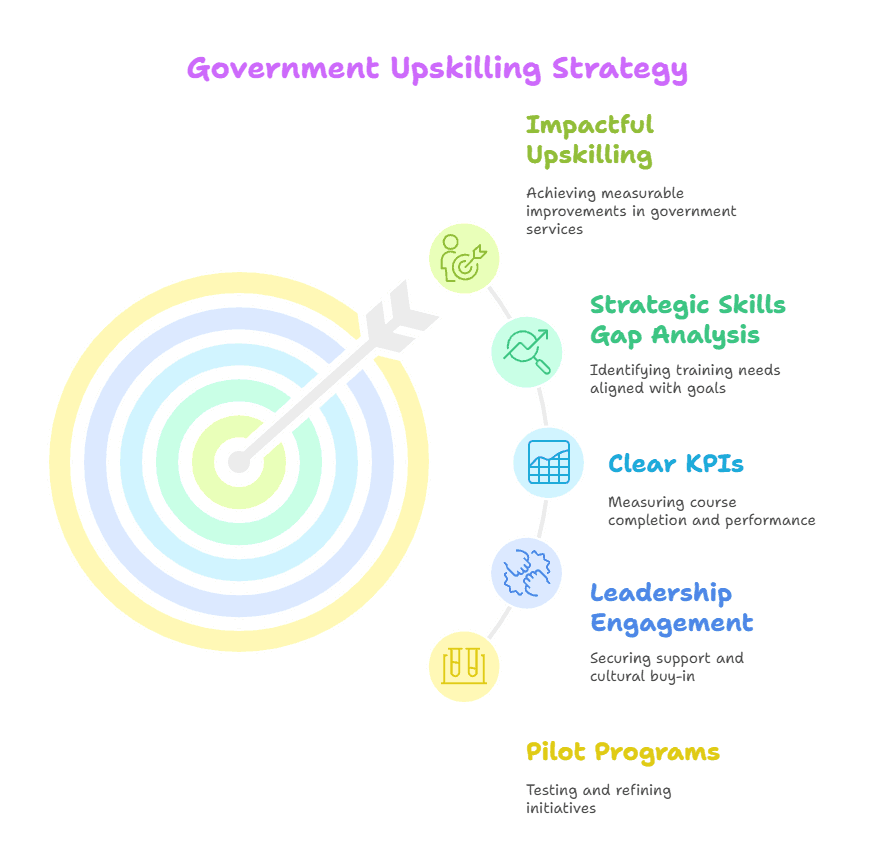
Conduct a Strategic Skills Gap Analysis
Align workforce capabilities with current and future ministry goals to pinpoint precise training needs.
Set Clear, Impact-Driven KPIs
Define metrics that measure not only course completion but also job performance, citizen satisfaction, and service delivery improvements.
Engage Leadership and Stakeholders Early
Secure executive support and involve department heads to drive cultural buy-in and ensure programs are embedded in daily operations.
Pilot Programs Before Scaling
Test initiatives with small groups to gather feedback, validate content relevance, and fine-tune delivery before nationwide rollout.
Use Real-Time Learning Analytics
Leverage LMS platforms to monitor engagement, track performance, and continuously adapt learning paths based on data insights.
Embed Mentorship and Peer Learning Models
Reinforce formal training with coaching, mentorship, and internal knowledge-sharing to promote sustained behavioral change.
These practices create a foundation for consistent growth, improved accountability, and long-term success across government institutions.
COURSINITY: YOUR PUBLIC SECTOR UPSKILLING PARTNER
At Coursinity, we build tailored, Saudi-aligned training programs that address real challenges and unlock strategic opportunities. From AI-driven learning journeys to blended mentorship and deep analytics, we support public agencies in building future-ready teams.
Partner with us to:
- Navigate cultural and digital readiness
- Leverage AI-powered personalization
- Measure real impact on performance and citizen satisfaction
Book a demo today to shape the future of public sector training.
Frequently Asked Questions
Q: How can ministries overcome resistance to training?
A: By involving leadership, explaining the purpose clearly, and offering support during change.
Q: What outcomes can be expected from smart upskilling?
A: Better employee performance, improved citizen services, higher engagement, and stronger alignment with Vision 2030.
Q: Is AI-driven learning practical in remote areas?
A: Yes, mobile-compatible and offline-access training platforms ensure inclusivity.
Q: What strategies can governments use to overcome upskilling challenges?
Governments can prioritize blended delivery, leverage partnerships with entities like HRDF and TVTC, provide leadership sponsorship, and implement real-time data tracking to continuously refine programs.
Q: What kind of support does Coursinity offer beyond training content?
A: We provide ongoing analytics, strategy guidance, and stakeholder alignment to ensure learning translates into results.
Share this post
Latest Posts
Blog
Employee training programs in Saudi Arabia compared by price, results, and ROI. Discover the best option for your organization today.
6 Min Read

Article
Saudi Arabia’s private sector in 2026 is moving fast, but not gently. It is being pulled in two directions at once: compliance pressure on one side, and massive Vision 2030 growth on the other. If you run a private company in the Kingdom, training is no longer a nice extra. It is the engine under the hood
7 Min Read

Article
When you’re browsing a training catalog, most courses look like they belong to the same family: expert trainer, polished slides, neat agenda, certificate at the end. But the real difference often shows up later when your employee tries to use that certificate in a tender, a professional license renewal, or a government support program… and suddenly, the paper in hand is not enough. So, which one should you choose: accredited courses or non-accredited courses?
7 Min Read